Movement · Particles · Interaction
NEVA
Enable your webcam to reveal your silhouette in NEVA.
Shared matter, singular presences
In NEVA, Olivier Delporte brings the human body into relation with a snowy landscape. The camera captures your presence and movements: your silhouette is recomposed from a multitude of white bubbles, like a body made of snow. Behind it, a landscape photograph taken by the artist welcomes this apparition. Snowflakes drift through the image; occasional flashes of lightning alter its light.
A snow crystal is built from water molecules. Its shape develops according to the temperature and humidity conditions encountered during its growth. For complex crystals, finding two exactly identical structures is extraordinarily unlikely. Their diversity thus arises from shared matter and different paths: a common origin does not impose a common form.
This relationship between resemblance and uniqueness echoes our biological makeup. Human beings share the vast majority of their DNA sequence — often summarised as approximately 99.9%, depending on how variations are counted. DNA relies on a shared alphabet; variations in its sequence contribute to our diversity. Our uniqueness also develops through each body’s growth, environment and lived history.
The bubbles of NEVA give poetic form to this shared matter. They evoke the molecules that make up our bodies and the DNA that contributes to their organisation. They are not a scientific representation: their assembly reveals a recognisable human presence, while every gesture transforms its contours. Like snow crystals, these presences combine a shared structure with a singular history.
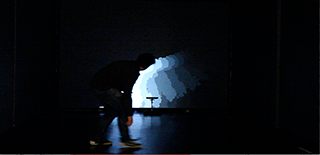
When you move, the silhouette breaks apart and leaves a blue trail behind it. The program retains these traces for a few seconds: this visual memory evokes a persistence of looking. Successive positions overlap, creating the impression that the particles merge and become identical. This merging remains a visual illusion: it changes neither the body’s molecules nor its DNA.
Between appearance and disappearance, NEVA questions what brings us together without erasing what distinguishes us. The body joins the landscape, snow becomes a sign of shared humanity, and movement reveals an identity that is constantly being recomposed.
How to use the installation
Enable your camera and allow access. Reduce the spacing to make the bubbles denser. Trails last 4 seconds by default; the slider lets you set their duration from 0 to 8 seconds. You can disable lightning in the settings.
Your webcam video is neither streamed live on the Internet nor recorded.
Even lighting and a simple background make it easier to isolate the body. Recognition is approximate: fingers, fast movements and obscured areas may be detected less accurately. The experience is designed for one person at a time.
The camera requires your permission. If opening the file locally blocks the camera or engine, open the page through localhost or an HTTPS site. An Internet connection loads the recognition engine. Images are processed in your browser and are not sent to a server. No microphone is used. “Stop” turns off the camera; leaving the tab suspends the experience.
A web adaptation of the principle behind corps2 — Kinect Physics Example, Amnon Owed, 15 September 2012, found in the supplied Processing archives. Kinect is replaced by MediaPipe person segmentation. This variant transforms the body mask into bubbles, drawing on the supplied reference photographs.